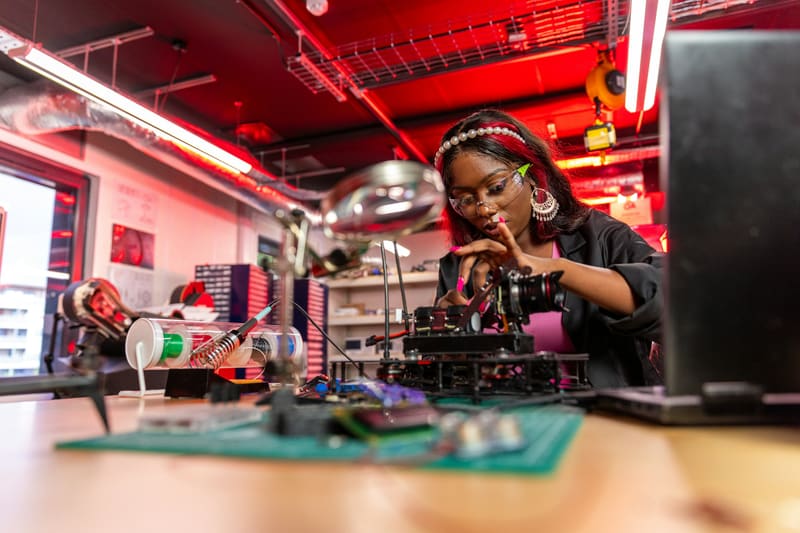
Photo: This is Engineering / Unsplash
That is the national number. Here is what it means where you are.
The labor market you can reach
The Census places Polk County in the Chattanooga, TN–GA commuting zone — the federal measure of where people who live here actually work. Technical roles cluster in that wider area, not necessarily inside the county line.
Where technical work sits here
Polk County has a mixed economy with no single dominant sector, which usually means a wider spread of smaller employers and more entry through IT support and systems roles than through any one industry.
What they report
"Latinas make up roughly 8% of the STEM workforce."
— the figure that appears in nonprofit annual reports, foundation grant applications, corporate diversity disclosures and federal program summaries.
It is not a fabricated number. It is a real count of a category that was drawn to include things that are not the same job.
What our research shows
We went to the source the aggregate is built from — the Bureau of Labor Statistics Current Population Survey, which publishes every occupation separately instead of pooling them — and read the technical occupations one at a time.
| Occupation | Latina share |
|---|---|
| Preschool & kindergarten teachers counted as STEM | 18.2% |
| Elementary & middle school teachers counted as STEM | 10.1% |
| Computer support specialists | 2.7% |
| Civil engineers | 2.7% |
| Industrial engineers | 2.6% |
| Mechanical engineers | 1.2% |
| Software developers | 1.2% |
| Electrical & electronics engineers | 1.1% |
The occupations at the top of that table are the ones inflating the headline. The occupations at the bottom are the ones the headline is used to describe.
How the two numbers are made
There is no statutory definition of a STEM job. Each organisation picks a boundary, and the broadest boundaries include K-12 teaching and computer support — the two categories with the highest Latina representation and the lowest pay in the whole set. Drawing the line there does this to the arithmetic:
| Where the boundary is drawn | Jobs counted | Latina |
|---|---|---|
| Technical and engineering work only | 5,159,000 | 1.99% |
| …with K-12 teaching added | 9,314,000 | 6.18% |
Adding teachers puts 4,155,000 more jobs into the denominator and triples the reported share. A single definitional choice moves the number from 2.0% to 6.2%, and the 8% figure sits in that range.
The claim survives only because of what was folded in. Preschool teaching is real work and it is badly underpaid — but it is not data engineering, it is not software development, and a report that counts them together is describing a workforce that does not exist. Strip the adjacent categories out and Latina representation in work that pays technical wages is 1.99%, against a Hispanic labor-force share near 19%.
That is a gap of roughly nine to one, and it does not appear in any annual report we could find.
What actually moves it
- WIOA-funded training — pays for the credential, ages 14 to 24 and adults: find your local office.
- Registered apprenticeship — a wage from day one instead of tuition: apprenticeship.gov.
- FAFSA — the gate to nearly all aid, free to file: studentaid.gov.
- Start at 14 — the youngest funded on-ramp we know of: work and paid training at 14.
En español
Hay aproximadamente 27,911 latinas trabajando como desarrolladoras de software en todo Estados Unidos — de 2,254,000 personas en esa ocupación. Las latinas son alrededor del 1.2% de esa profesión, mientras que los hispanos representan casi el 19% de la fuerza laboral del país.
Cuando una organización dice "latinas en STEM" e informa un número mucho más alto, generalmente está incluyendo maestras de preescolar y soporte técnico. Ese trabajo es real y está mal pagado — pero no es ingeniería de datos.
El dinero federal para entrenamiento ya existe: busque su oficina local.
Photographs on this campaign are licensed stock used as illustration — not portraits of people in the BLS counts. Full credits: CREDITS.md.